
The short answer
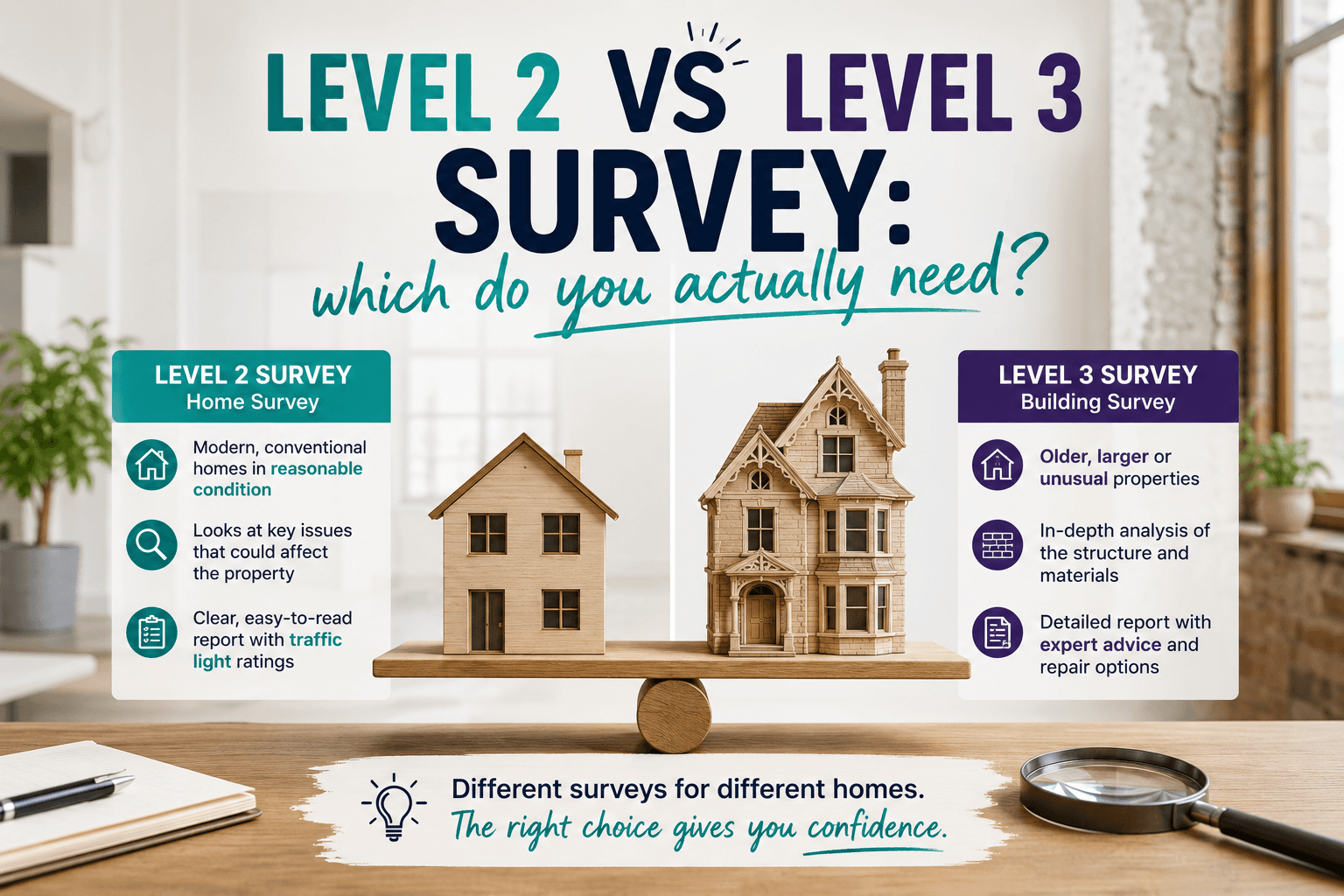
A RICS Level 2 HomeBuyer Report is designed for post-1900 conventional homes in reasonable condition. A RICS Level 3 Building Survey is designed for pre-1900 stock, extended or altered properties, non-standard construction, and homes showing visible signs of movement, damp, or general wear and tear.
If you are already turning that description over in your head and thinking “that sounds like my house”, trust the instinct — it is usually right. Where it gets less obvious is anything in between: a 1960s semi with a 1990s rear extension, a 1930s house with rendered solid walls, or a flat above a shop. That is where the framework below earns its keep.
Typical Level 2 fee on a standard home
How much more a Level 3 typically costs over a Level 2
Report turnaround for either survey level
What each level actually inspects
Roof and roof space. Level 2: a visual check from the hatch where accessible. Level 3: full roof space entry with structural comment on rafters, purlins and any historic repairs.
Walls and structure. Level 2: condition ratings only. Level 3: a cause-and-effect narrative on cracking, movement and previous underpinning.
Damp and timber. Level 2: moisture meter readings and a rating. Level 3: a full diagnosis of the mechanism (rising, penetrating, condensation) and the remedy.
Below-ground and drainage. Level 2: visible drainage only. Level 3: manhole inspection and comment on likely below-ground condition.
Services. Both levels give a visual check and recommend specialist testing — neither is a certified electrical or gas test.
Why getting this right matters more than the fee
The temptation is to treat the choice as a £200-£400 saving and book the cheaper option. That works fine on the property it is designed for. It works badly on the property it is not designed for, because a Level 2 on a pre-1900 solid-wall house will rate the damp and the cracking, but it will not tell you why it is happening or what it will cost to fix — and cause is the entire point on older stock.
Equally, a Level 3 on a straightforward 1990s cavity-wall semi in good order is thorough but usually more depth than the property needs. Our surveyors will tell you honestly, at no charge, if we think you are over- or under-specifying — we would rather get the level right than sell you the more expensive product.
Choose a Level 3 if your home is…
- • Built before 1900, or of solid-wall or non-standard construction
- • Extended, altered, or has had a loft or basement conversion
- • Showing visible cracking, bowing walls, or signs of movement
- • A listed building, or in a conservation area with unusual materials
- • Somewhere you are planning significant renovation work
A Level 2 is usually enough if your home is…
- • Built from 1900 onwards, of standard brick-and-block or cavity construction
- • Unaltered, or only lightly modernised
- • Free of visible cracking, damp staining or structural concern
- • A straightforward flat, terrace, semi or detached house
- • A property you plan to move into as-is, without major works
“Buyers ask us to save money by downgrading from a Level 3 to a Level 2 far more often than the other way round. It is the one piece of advice we won’t bend on: get the level right for the property, not for the budget.”
Still deciding between Level 2 and Level 3?
Tell us the property’s age and condition and we’ll recommend the right level, free of charge.
Get a quoteThe cost difference, and why it’s worth it
A Level 3 typically costs 30-60% more than a Level 2 on the same property, which on a £250,000 home might mean the difference between roughly £550 and £850. Set against the purchase price, that gap is small; set against the cost of a single mis-diagnosed damp problem or an unrecognised structural crack, it is negligible.
The properties where a Level 3 pays for itself hardest are the ones with a story: an extension without visible building control sign-off, a loft conversion, a house that has clearly had render or pointing redone recently. A Level 3 is built to interrogate exactly that kind of history.
Level 2 vs Level 3 FAQs
Still not sure which one you need?
If you are still torn, take our short survey picker for a recommendation on screen, or give us the postcode, the approximate age, and anything you already know about extensions or alterations. A RICS Regulated surveyor will confirm the right level before you book. It costs nothing, and it is the fastest way to stop second-guessing the decision.
A step-by-step walkthrough for first-time buyers: what to book, when to book it, how to read the report, and how to renegotiate on defects.
A practical decision guide to choosing between a RICS Home Survey Level 2, a Level 3 Building Survey or a valuation — by construction, type and condition.